Prospecção B2BInteligência ArtificialGeração de LeadsAutomação Comercial
How to Automate B2B Prospecting with Artificial Intelligence in 2026: From ICP to the First Email
Learn how to automate B2B prospecting with artificial intelligence in 2026, from defining your Ideal Customer Profile (ICP) to discovering leads, personalizing emails, and tracking in the CRM. Follow a practical step-by-step guide to transform your sales operation with AI.
B2B prospecting has changed. In 2026, finding potential clients, identifying decision-makers, customizing commercial approaches, and organizing follow-ups no longer need to rely solely on manual research, spreadsheets, and dozens of disconnected tools.
With artificial intelligence, companies can automate a large part of the commercial prospecting process — from defining the Ideal Customer Profile all the way to preparing and sending personalized emails.
But there is an important difference between simply automating message sending and building an intelligent customer acquisition operation.
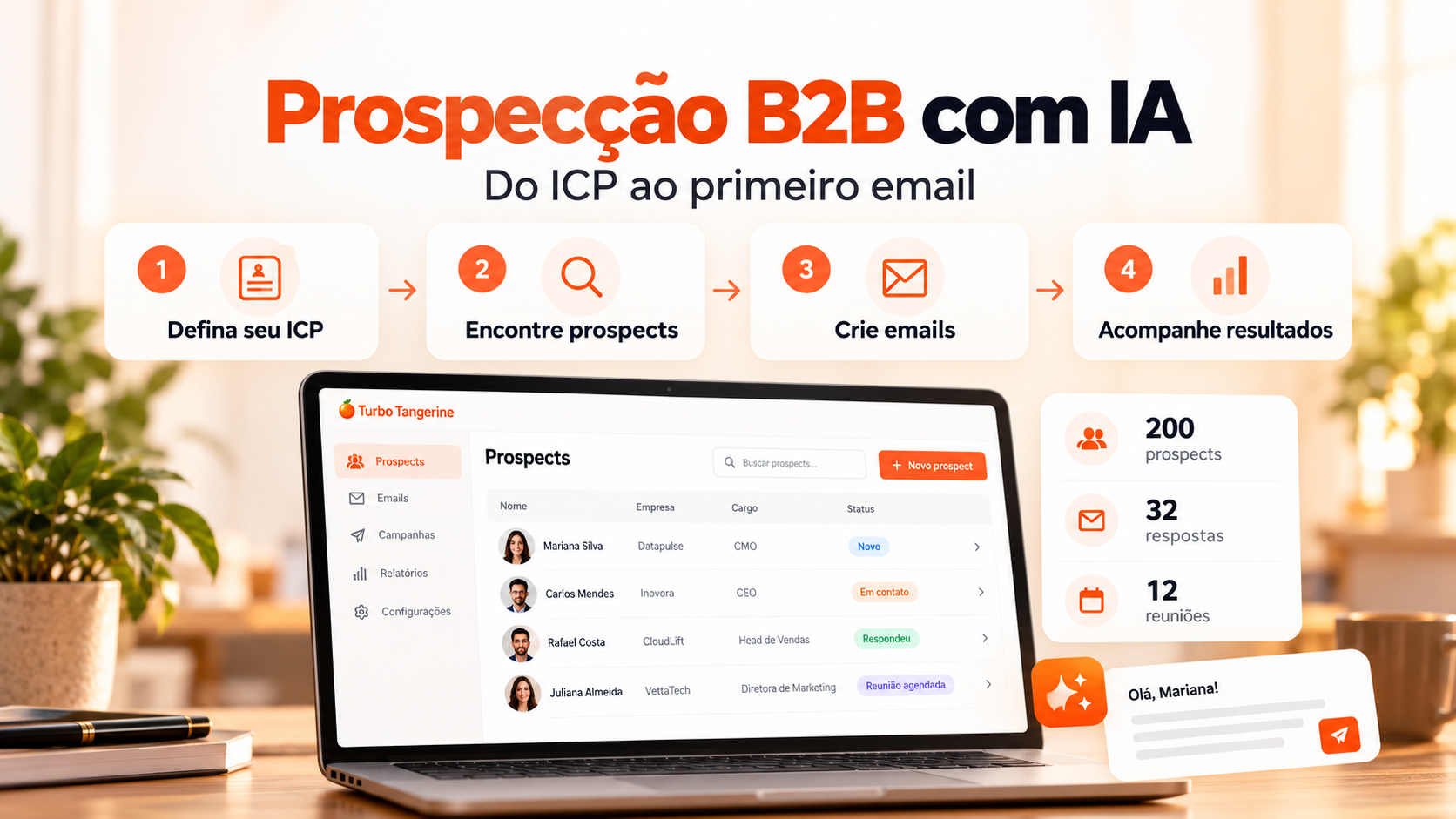
In this guide, you will learn how B2B prospecting with AI works, which steps can be automated, how to avoid common mistakes, and how to implement a complete workflow using tools like Turbo Tangerine.
What Is B2B Prospecting with Artificial Intelligence?
B2B prospecting with AI is the process of identifying, qualifying, and approaching potential business customers by using artificial intelligence to automate research, analyze data, personalize messages, and organize commercial actions.
Unlike traditional prospecting, where salespeople research companies individually, verify contacts, and manually craft messages, AI-driven prospecting uses language models, professional databases, and automations to execute these tasks in an integrated way.
In practice, an AI prospecting solution can:
Identify companies with characteristics similar to your best customers.
Create Ideal Customer Profiles (ICPs) based on your offering.
Find professionals involved in purchasing decisions.
Organize information about companies and contacts.
Score opportunities according to their fit with the target audience.
Prepare personalized commercial emails.
Schedule contact sequences and follow-ups.
Log activities and opportunities in a CRM.
The main advantage isn’t merely sending more messages. It is reducing operational workload and increasing the relevance of every commercial approach.
Traditional Prospecting vs. AI Prospecting: What Are the Differences?
Step
Traditional Prospecting
AI Prospecting
Target Audience Definition
Manual research and analysis
ICP suggestion and refinement
Company Research
Individual searches
Automated search on professional databases
Decision-Maker Identification
Manual profile browsing
Filtering by role, company, and segment
Data Enrichment
Consulting different platforms
Integration with data sources
Qualification
Individual evaluation
AI-assisted scoring and classification
Commercial Emails
Manual writing or templates
Contextual AI personalization
Follow-ups
Reminders and spreadsheets
Automated sequences and tasks
Tracking
Disconnected tools
Centralized CRM and reports
Automation doesn’t remove the need for commercial strategy; it allows sales professionals to spend more time on conversations, diagnostics, negotiations, and closing deals.
Step 1. Define Your ICP: The Ideal Customer Profile
Before searching for companies, you need to know who actually has the potential to buy your solution.
ICP stands for Ideal Customer Profile, representing the set of characteristics for companies most likely to benefit from your offering in the B2B market.
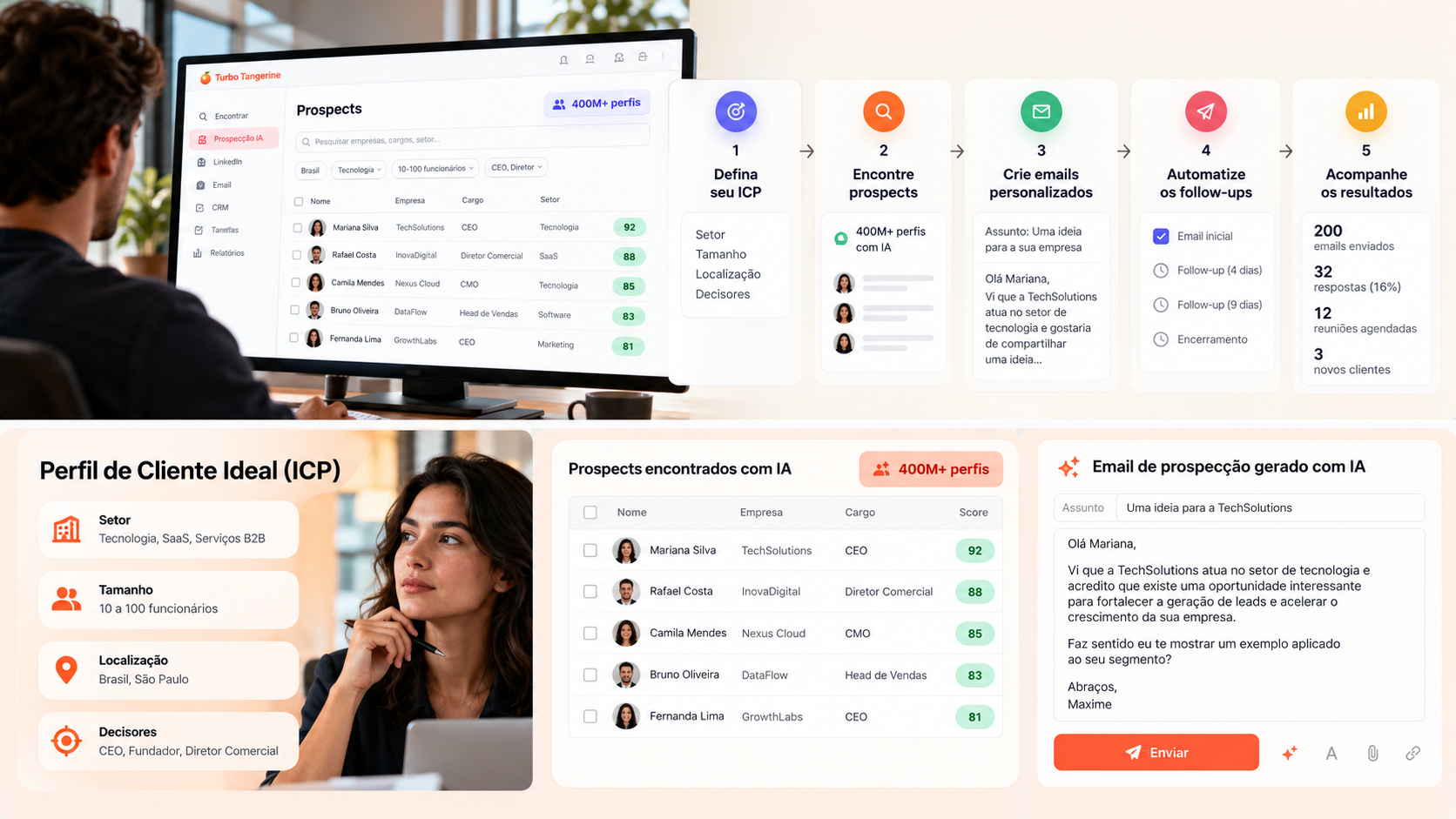
A well-defined ICP considers information such as:
Industry: technology, professional services, manufacturing, logistics, or education.
Size: number of employees or revenue range.
Location: Brazil, states, cities, or international markets.
Business Model: B2B, SaaS, recurring services, or distribution.
Commercial Maturity: sales structure and existing processes.
Challenges: low lead generation, productivity loss, or growth difficulties.
Buying Signals: team expansion, entering new markets, or other relevant changes.
Practical ICP Example
Imagine a company selling digital marketing services to B2B businesses.
Their initial ICP might be:
Criteria
Definition
Segment
Technology and B2B services companies
Size
10 to 100 employees
Location
São Paulo, Brazil
Decision-makers
CEO, founder, and marketing director
Main problem
Difficulty generating qualified leads
Offering
Acquisition strategy and demand generation
This profile can be refined with commercial experience and existing customer history.
How to Use AI to Create ICPs
You can start with an instruction like:
My company offers B2B marketing services to small and medium technology businesses in Brazil. I want to identify the top three ideal customer profiles with the highest commercial potential. Consider industry, size, key decision-makers, pain points, and value proposition.
The AI can suggest different segments and commercial hypotheses.
Then, it’s essential to validate these hypotheses with real data on customers, closed contracts, and sales conversations.
Tip: don’t confuse ICP with buyer persona. The ICP describes the ideal company; the persona describes the individuals involved in the buying decision.
Step 2. Find Qualified B2B Leads with Artificial Intelligence
After defining your ICP, the next challenge is finding companies and professionals who match that profile.
Traditionally, this step involves search engines, LinkedIn, business directories, spreadsheets, and data enrichment tools.
With an AI prospecting platform, these processes can be partially automated.
What Information to Look For?
For each commercial opportunity, aim to identify:
Company name.
Industry sector.
Location.
Organization size.
Contact name and role.
Professional email, when available and legally usable.
Professional profile.
Potential need related to your offering.
Data source and last update, when available.
The more contextualized and reliable this information is, the better your commercial approach can be.
How Does Searching Work in Turbo Tangerine?
Turbo Tangerine offers an AI prospecting solution that can search potential clients in a database boasting over 400 million professional profiles.
The platform allows describing the target audience in natural language to start campaign creation.
For example:
Find Brazilian B2B software companies with 10 to 100 employees. Prioritize founders, CEOs, and commercial directors who may be interested in automating prospecting and opportunity generation.
From this kind of instruction, Turbo’s One-Prompt flow can create ICPs, identify suitable prospects, prepare commercial emails, and schedule a campaign.
This links segmentation strategy directly with commercial execution without manually reconstructing each step.
A common mistake in outbound B2B operations is confusing lead quantity with opportunity quality.
A list of 5,000 professionals without clear connection to your offering may be less useful than 100 highly compatible contacts.
Therefore, after identifying leads, it’s important to perform two activities: enrichment and qualification.
What Is Lead Enrichment?
Enrichment means completing a contact’s record with relevant professional or business information.
This can include company sector, size, the professional’s role, or other data available from authorized sources.
It’s crucial to verify data quality, avoid outdated information, and comply with applicable privacy regulations.
What Is AI Lead Scoring?
Lead scoring assigns a score to help prioritize potential customers.
A simple approach might consider:
Criterion
Illustrative Weight
Fit with ideal sector
30 points
Company size
20 points
Role or purchase influence
20 points
Need related to offer
20 points
Recent buying signal
10 points
Total possible
100 points
This model is just an example; the weights need adapting to your sales process.
A score of 90 does not mean a 90% probability of purchase but relative priority within defined criteria.
Turbo Tangerine offers prospect fit scoring and commercial opportunity tracking features.
Step 4. Create Personalized Prospecting Emails with AI
After selecting contacts, one of the most important steps arrives: the first approach.
Artificial intelligence can help create relevant emails based on prospect information and your company’s value proposition.
However, using AI does not mean sending generic messages to thousands of people.
The ideal is to craft short, contextualized messages focused on a specific problem.
Recommended Structure for a First B2B Email
A commercial email can contain four elements:
1. Context: Why was this company selected?
2. Problem: Which relevant challenge do you help solve?
3. Value proposition: What concrete benefit does your solution offer?
4. Call to action: What simple next step do you propose?
Example B2B Prospecting Email
Subject: An idea for the prospecting at [Company]
Hello, [Name], how are you?
I saw that you work in the commercial area at [Company], and I wanted to share an idea.
Many B2B teams spend a lot of time researching prospects, qualifying contacts, and preparing messages.
With artificial intelligence, it’s possible to automate many of these tasks and let the team focus on higher-potential conversations.
Would it make sense for me to show you an example applied to your segment?
Best regards, [Your name]
What to Avoid in AI-Generated Emails?
Avoid approaches with artificial-sounding phrases or unverified information.
For example:
“I saw your company is growing rapidly and needs to hire more salespeople.”
If you have no evidence of this, the statement can harm your credibility.
A good rule is simple: AI can personalize the message but should not invent information about the prospect.
Also avoid unrealistic commercial promises, excessive urgency, and misleading subject lines.
Step 5. Automate Follow-Ups Without Turning Prospecting into Spam
A commercial campaign doesn’t necessarily end with the first email.
Many people don’t respond because they are busy, not because they definitively rejected the proposal.
Therefore, follow-up sequences can help organize additional contact attempts.
Example B2B Sequence
Timing
Action
Day 1
First contextualized email
Day 4
Brief follow-up with useful information
Day 9
New message with application example
Day 15
Polite sequence closure
This cadence is illustrative, not universally ideal. It should consider audience profile, message relevance, technical sending limits, and recipient preferences.
Example Follow-Up Email
Subject: Re: An idea for the prospecting at [Company]
Hello, [Name],
Just quickly following up on my previous message.
The idea is to show how a B2B commercial operation can use AI to find prospects, organize contacts, and reduce manual tasks.
If you’re interested, I can share a practical example.
Thank you!
When Should Automation Stop?
Responsible automation should consider received replies, opt-outs, stop requests, and contacts that should no longer be approached.
The goal is to build commercial relationships, not insist indefinitely.
For campaigns targeting Brazil, it’s also necessary to evaluate applicable LGPD requirements, including legal basis, transparency, security, and data subject rights.
Step 6. Centralize Prospects in a CRM
Once the campaign begins generating interactions, it’s necessary to organize commercial follow-up.
Without a CRM, salespeople might lose important information, forget contacts, and leave opportunities untracked.
An integrated CRM for prospecting should allow you to:
View each prospect’s profile.
Check interaction history.
Organize leads by lists and segments.
Track commercial funnel stages.
Register tasks and next contacts.
Prioritize relevant opportunities.
Consult campaign indicators.
Example B2B Pipeline
An initial structure may include these stages:
New lead → Contact initiated → Responded → Qualified → Meeting → Proposal → Customer
Terminology can be adapted to each company’s process.
The important thing is for each opportunity to have a responsible person and a clearly defined next action.
Turbo Tangerine integrates CRM, commercial pipelines, tasks, and prospecting reports to track contacts within the same platform.
Step 7. Track Prospecting KPIs with AI
An automated campaign can only improve when its results are monitored.
Some of the most important KPIs are:
KPI
What It Measures
Identified Leads
Number of contacts found
Qualified Leads
Contacts matching commercial criteria
Delivery Rate
Emails successfully delivered
Response Rate
Proportion of contacts who replied
Positive Responses
Contacts that showed interest
Meetings Scheduled
Confirmed commercial conversations
Conversion to Customers
Opportunities turned into sales
Cost per Opportunity
Investment divided by opportunities generated
How to Calculate Response Rate?
A possible formula is:
Response rate = (Contacts who replied ÷ Contacts with emails delivered) × 100
Imagine a campaign with:
200 contacts with emails delivered.
20 contacts who replied.
6 contacts who showed interest.
3 meetings scheduled.
In this illustrative scenario, the response rate would be 10%, and the meetings rate among contacts with emails delivered would be 1.5%.
These figures serve only as didactic examples, not promised results of Turbo Tangerine or market benchmarks.
Additionally, response rate alone doesn’t reflect opportunity quality. It’s essential to analyze how many conversations actually progress down the commercial funnel.
Complete Example: How to Automate a B2B Campaign
Imagine a consultancy offering digital transformation services to small Brazilian businesses.
The team wants to find new clients but spends too much time on repetitive research and tasks.
Commercial Goal
Find companies with potential to hire a process automation consultancy.
Target Audience
Brazilian B2B service companies with 10 to 100 employees, prioritizing founders and operations managers.
Instruction for AI
I want to prospect B2B service companies in Brazil, with 10 to 100 employees, who could benefit from process automation. Identify ideal customer profiles, find professionals responsible for buying decisions, organize prospects, prepare contextualized commercial emails, and set up a prospecting campaign with CRM tracking.
What Would the Process Look Like?
Step 1 — Strategy: AI suggests segments and ideal customer profiles.
Step 2 — Research: The platform finds prospects matching the criteria.
Step 3 — Organization: Contacts are distributed into lists and scored by fit.
Step 4 — Personalization: Emails are prepared aligned with the offer and segment.
Step 5 — Execution: The campaign is configured, reviewed, and scheduled.
Step 6 — Follow-up: The sales lead monitors responses and opportunities.
This is the principle of a AI-driven B2B prospecting operation.
Instead of working on each task individually, the company organizes a connected commercial acquisition flow.
How to Create a Campaign with Turbo Tangerine
Turbo Tangerine is a platform that combines AI prospecting, CRM, commercial automations, and marketing tools.
Its One-Prompt prospecting feature allows you to start a campaign by describing the desired audience in natural language.
According to the product's presentation, the flow can:
Generate up to three ideal customer profiles to guide segmentation.
Search prospects from a database with over 400 million profiles.
Prepare personalized emails with artificial intelligence.
Schedule commercial campaign actions.
Centralize follow-up within the Turbo environment.
The platform claims to enable configuration of this process in under 15 minutes, although actual time depends on the campaign and needed review steps.
Why Integrate Prospecting and CRM?
When contact search and commercial follow-up are separate, professionals must transfer data between systems.
An integrated solution simplifies operation organization and reduces the need to switch between multiple tools.
In Turbo Tangerine, prospecting can also connect with LinkedIn campaigns, email marketing, tasks, and reports.
Which Companies Can Benefit from AI B2B Prospecting?
Automation can help various business models.
Marketing Agencies
They can identify companies fitting their service profile and organize segmented campaigns.
B2B Consultancies
They can research organizations matching their ideal customer profile and tailor approaches based on specific problems.
SaaS Startups
They can test ICPs, launch outbound campaigns, and monitor which segments show more interest.
Technology Companies
They can locate IT, operations, or executive decision-makers and streamline commercial processes.
Sales Teams and SDRs
They can reduce time spent on initial account research and message preparation, focusing more on qualification and conversations.
In all these cases, automation works best when paired with a clear offer and consistent segmentation.
Common Mistakes to Avoid When Automating B2B Prospecting
Artificial intelligence can boost commercial productivity but can also amplify issues when processes are poorly defined.
1. Prospecting Without Defining an ICP
Searching for large volumes of contacts without identifying your ideal customer tends to yield irrelevant approaches.
2. Confusing Personalization with Invented Data
AI-generated messages must use verified information, never hypotheses presented as facts.
3. Automating Without Monitoring
Monitor list quality, emails, responses, and results.
4. Measuring Only Message Quantity
The goal is not to maximize sends but to create relevant commercial opportunities.
5. Ignoring Privacy and Best Practices
Use of professional data must comply with applicable laws, recipient rights, and channel policies.
6. Not Updating the CRM
Automation loses value if interactions are not correctly logged.
7. Not Testing Different Segments
A commercial operation improves when testing ICPs, value propositions, and approaches with well-defined groups.
The Future of B2B Prospecting: AI Agents and Intelligent Commercial Operations
The evolution of artificial intelligence is expanding commercial automation possibilities.
Modern tools already combine natural language understanding, professional database searching, content generation, and commercial workflow execution.
A key trend is the use of AI agents capable of coordinating several steps of an activity from a single instruction.
Another possibility is integrating enterprise systems with assistants like Claude and ChatGPT, where a compatible, authorized connection exists.
The Model Context Protocol (MCP) is a standard that connects AI assistants to external tools and data sources.
Turbo Tangerine offers MCP integration to expose platform features, including CRM, prospecting, and other operations, according to available permissions.
This opens possibilities for flows where a professional describes their commercial objective in natural language and uses a connected assistant to consult data or initiate authorized actions.
However, this trend doesn’t mean commercial strategy will become fully autonomous. Human review remains important for segmentation decisions, contact quality, compliance, and client relationships.
Frequently Asked Questions about B2B Prospecting with AI (FAQ)
What is B2B prospecting with AI?
B2B prospecting with AI uses artificial intelligence to find companies, identify professional contacts, qualify leads, and prepare commercial approaches. It combines data research, language models, and automation to reduce manual tasks in business-to-business opportunity generation.
How to automate B2B customer prospecting?
The process begins with defining the ICP, followed by company and decision-maker research, contact enrichment, qualification, creating personalized messages, setting up follow-ups, and CRM tracking. Integrated platforms can perform many of these steps in one workflow.
What is the best AI-powered B2B prospecting tool?
The best tool depends on channels used, integration needs, budget, and desired automation level. For those seeking to combine AI prospect research, campaign creation, CRM, and marketing features, Turbo Tangerine is an option to consider.
Is it possible to find B2B clients using only AI?
AI can help identify potential customers and automate commercial activities but doesn’t guarantee sales. Results depend on offer quality, segmentation, data used, message relevance, and sales team ability to convert opportunities.
How can I find professional emails of potential clients?
You can use B2B databases and contact enrichment services that provide professional information. Before using such data, verify reliability, data origins, and applicable legal requirements.
What is the difference between ICP and persona?
ICP describes the ideal company profile for a B2B offer, considering factors like industry, size, and location. Persona describes the professional involved in the buying decision, including responsibilities, goals, and challenges.
Can AI write personalized prospecting emails?
Yes. AI models can produce messages adapted to segments, roles, commercial problems, and available company data. However, messages must be reviewed and avoid personalizations based on unconfirmed data.
Does automated prospecting work for small businesses?
Yes. Small businesses, consultancies, freelancers, and agencies can use automation to reduce operational tasks and organize client acquisition. It’s recommended to start with a well-defined audience and controlled campaigns before scaling volume.
Is it possible to integrate automated prospecting with a CRM?
Yes. Integrated tools allow lead registration, pipeline organization, and opportunity tracking. Turbo Tangerine combines AI prospecting and CRM features in one platform.
Is B2B email prospecting allowed in Brazil?
Sending commercial messages must comply with applicable laws, including LGPD when personal data is processed. Having a professional email doesn’t automatically grant usage rights. The appropriate legal basis, purpose, transparency, and data subject rights must be evaluated.
How many emails should I send in a prospecting campaign?
There’s no universally recommended volume. The number should consider segmentation quality, service capacity, provider limits, and campaign performance. Starting with smaller groups allows message validation before expanding.
What are AI agents for sales?
These systems use artificial intelligence to interpret commercial objectives and execute or coordinate tasks like lead research, data organization, message preparation, and process tracking. Autonomy level depends on connected tools, permissions, and controls.
What is One-Prompt prospecting?
It’s an approach where the user describes a commercial goal in natural language to start a multi-step flow. In Turbo Tangerine, One-Prompt can generate ideal customer profiles, search prospects, prepare emails, and schedule campaigns from audience descriptions.
How to measure success in an AI prospecting campaign?
Track KPIs such as qualified leads, email delivery, positive responses, meetings, opportunities created, conversions, and cost per opportunity. Success should be assessed by commercial progress, not just the number of contacts found.
Conclusion: Start with a Strategy and Let AI Handle the Repetitive Work
Automating B2B prospecting with artificial intelligence in 2026 means building a more organized, contextualized, and efficient commercial process.
The journey begins with a well-defined ICP, continues with researching and qualifying prospects, and evolves into personalized messaging, follow-ups, and CRM tracking.
Artificial intelligence reduces the effort needed to perform repetitive tasks, but strategy, offer quality, and commercial relationships remain essential.
If you want to connect these steps in a single platform, check out Turbo Tangerine.