Prospección en LinkedInSeñales de IntenciónProspección B2BSocial Selling
LinkedIn Signals: How to Use Them to Prospect at the Right Time
What if you could identify your future clients exactly when they need you? Job changes, new hires, fundraising, interactions with competitors, profile visits... Discover 38 practical cases of using LinkedIn signals and sales tactics to detect opportunities, qualify your prospects, and automate your B2B prospecting with AI.
Prospecting on LinkedIn is no longer just about finding a list of decision-makers and sending them the same message.
The real challenge now is knowing who to contact, why to contact them, and above all, when.
That is exactly the role of LinkedIn prospecting signals.
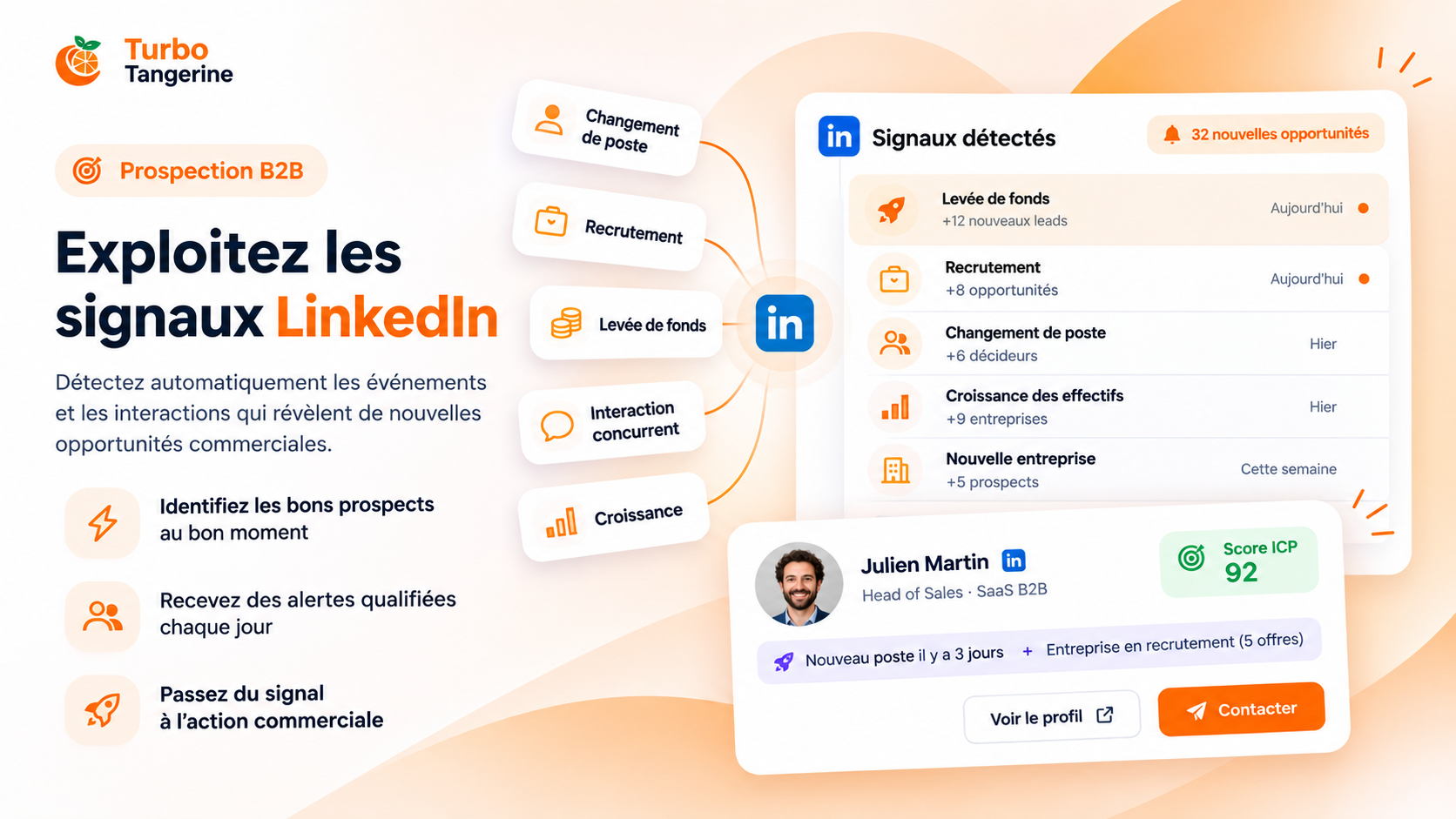
A visit to your profile, a job change, a company hiring, a funding round, a prospect commenting on a competitor's post, or the arrival of a new decision-maker are many events that can reveal a business opportunity.
By detecting these signals automatically, a company can transform its B2B prospecting into a much more contextual approach:
Signal detected → prospect qualification → identification of the right angle → personalized contact → commercial follow-up.
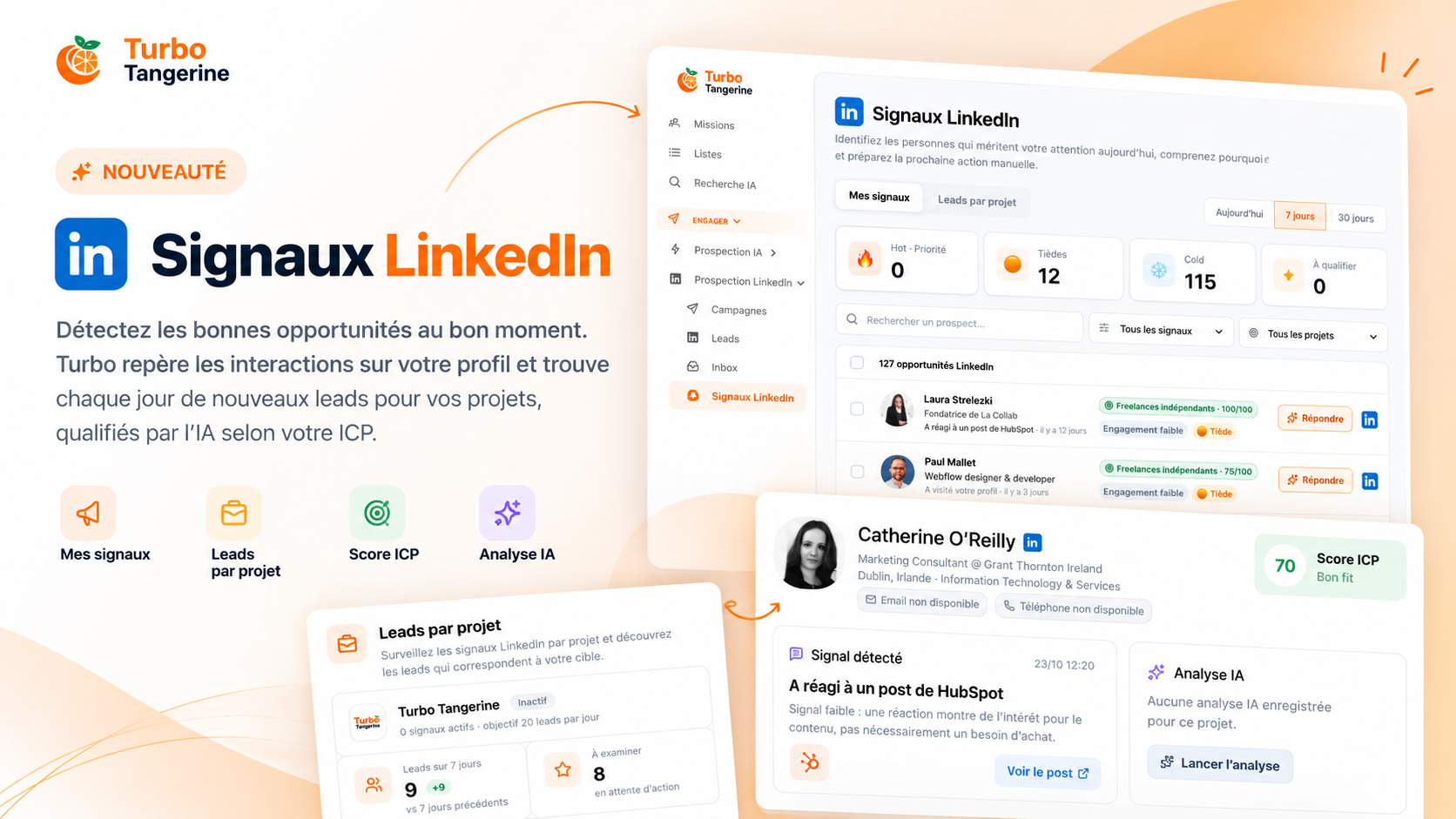
Turbo Tangerine precisely allows associating prospect research and enrichment with campaigns and sequences on LinkedIn, then centralizing leads and conversations in the CRM.
What is a LinkedIn prospecting signal?
A prospecting signal is an event that indicates that a person or company may be more likely to have a need, a project, or a purchase intent.
Let's take a simple example.
Two marketing directors perfectly match your ICP.
The first has taken no particular action in the last six months.
The second has just:
joined a new company,
published several contents about artificial intelligence,
and your company has just hired three marketing profiles.
Both prospects theoretically have the same profile.
But commercially, the second shows many more signals indicating that a conversation may be relevant now.
That is the whole difference between prospecting based only on static criteria and prospecting based on signals of intention and change.
Why use LinkedIn signals for prospecting?
Traditional approaches often start with a database:
“Find for me the sales directors of French SaaS companies with 20 to 200 employees.”
This method is still useful for identifying your market.
But it does not answer an essential question:
Why contact this person today and not in three months?
Signals add this temporal dimension.
A prospect becomes a priority because an event has just happened.
For example:
A company hires 10 salespeople. It may need CRM, prospecting, onboarding, or training tools.
A sales director has just been appointed. He will likely audit the tools, processes, and performance of his team.
A prospect visits your LinkedIn profile. They already know your name and your company.
A company has just raised 5 million euros. It potentially has new budgets and growth goals.
A prospect comments on a competitor's post. They already show interest in your product category.
Prospecting thus goes from:
“You match my target audience.”
to:
“Something has happened that makes my offer relevant to you.”
1. Prospect the people who interact with your competitors
Signal: reactions on competitors' pages
This signal detects people who like, comment, or interact with posts on your competitors' LinkedIn pages.
It is particularly interesting when a competitor publishes content directly related to the problem your product solves.
Example
You market a B2B prospecting software.
A competitor publishes:
“7 methods to find prospects on LinkedIn.”
A sales director comments on the post.
This interaction constitutes a signal of interest in the topic.
Instead of sending:
Hello, we offer a B2B prospecting solution.
you have a much more interesting context:
I saw that LinkedIn prospecting is a topic that interests you. We are precisely working on an approach that allows automatically detecting the best times to contact prospects.
Use case
This signal can be used to:
identify prospects already interested in your category;
find the audience of your competitors;
detect problems mentioned in comments;
create much more qualified prospecting audiences;
identify people who potentially compare various solutions.
2. Monitor strategic LinkedIn accounts
Signal: accounts you monitor
You can monitor people who interact with posts from chosen LinkedIn accounts.
These accounts do not necessarily have to be competitors.
They can be:
influencers;
specialized media;
consultants;
professional associations;
partners;
experts in your industry.
Keywords then allow you to target truly interesting interactions.
Example
A company that sells HR software could monitor experts who regularly post about:
recruitment, employer branding, turnover, onboarding, or talent management.
A person who comments on several posts about turnover may become an interesting prospect.
3. Detect people who are already talking about your problem
Signal: mentions by keywords
Turbo can detect people who post on LinkedIn using certain keywords, even if you do not follow them.
This is one of the signals most directly related to intent.
Example
A cybersecurity specialized agency could monitor:
ransomware;
ISO 27001;
cybersecurity;
data breach;
phishing;
SOC 2.
When a CIO posts:
"We are beginning our preparation for ISO 27001."
there is immediately a commercial context.
Use case
This approach works particularly well to detect:
the expression of a problem;
the search for a solution;
the launch of a project;
the use of a technology;
a new strategic priority.
4. Prospect companies that are hiring
Signal: companies that are hiring
A recruitment campaign often reveals much more than a simple HR need.
It can indicate:
growth;
formation of a new team;
opening of a market;
investment in a specific function;
an internal transformation.
Example: selling a sales tool
A company posts eight vacancies for:
SDR;
Account Executive;
Sales Manager.
It is probably accelerating its sales machine.
This is an excellent moment to propose:
a CRM;
a prospecting solution;
data enrichment;
sales training;
a sales enablement tool.
Example: selling a tool for developers
A company begins hiring:
5 developers;
a CTO;
2 DevOps.
This may indicate a significant technological acceleration.
A company that sells monitoring, cloud, security, or infrastructure solutions can use this hiring as a trigger.
5. Monitor job offers of your target accounts
Signal: offers from your accounts
When you already have a list of target companies, monitoring their new job offers allows you to automatically detect priority changes.
Example
You target 500 companies.
Instead of asking your salespeople to regularly check LinkedIn pages, the system detects that a company is suddenly looking for:
Head of AI
or
AI Engineer.
If your company sells a solution related to artificial intelligence, this signal becomes extremely relevant.
6. Use job changes
Signal: job change
A job change is one of the most powerful B2B signals.
Why?
Because a new manager generally has a period during which they must:
analyze the existing;
define their priorities;
replace some tools;
recruit;
select new service providers;
achieve results quickly.
Example
A CRM contact becomes Head of Sales at a new company.
A few weeks earlier, they might not have had any reason to buy your solution.
Now, he may need to build his entire business strategy.
Another opportunity
If this contact was already a client or user at his former company, his job change may also become an opportunity to develop your solution at his new company.
7. Won public tenders
Signs: won public tenders in France and Brazil
A company that wins a tender has just secured a new contract.
This signal can reveal:
an increase in activity ;
a new project ;
recruitment needs ;
new supplier needs ;
new investments.
Example
An IT services company wins an important public contract.
A company that sells:
cybersecurity ;
recruitment ;
cloud ;
outsourcing ;
project management solutions
can use this information to trigger a targeted campaign.
This type of signal is particularly interesting because it is based on a concrete economic event, and not only on online behavior.
8. Prospecting newly-created companies
Signal: newly registered companies
A new company usually needs to purchase many services during its first months.
For example:
accounting ;
banking ;
insurance ;
software ;
website creation ;
marketing ;
recruitment ;
telephony ;
cybersecurity ;
commercial tools.
Example
A web agency could monitor newly created companies weekly in certain sectors and states.
Instead of waiting for those companies to search for a provider on Google, it can contact them a few days after their creation.
Use signals coming from your own LinkedIn profile
Not all signals require monitoring external companies.
Some of the best business opportunities are already around your LinkedIn profile.
9. New followers
Someone who just followed your profile already shows a first level of interest.
Obviously, one should not consider every follower as a prospect ready to buy.
But if the person also matches your ICP, they become much more interesting than a completely cold contact.
Possible workflow
New follower → fit verification → enrichment → scoring → CRM addition → interaction or contact.
10. Comments on your posts
A comment is usually a stronger signal than a simple like.
It can reveal:
a problem ;
an opinion ;
an objection ;
an experience ;
a question.
Example
You publish an article about prospecting automation.
A sales director responds:
“The problem in our company is not finding prospects, but having time to follow up with them.”
He practically provided the angle of the conversation.
The correct approach is not:
Thank you for your comment. Would you like a demo?
But rather to naturally continue the discussion about his problem.
11. Reactions to your posts
A like is a weaker signal than a comment, but it becomes interesting when repeated.
A person who reacted to:
a post ;
then to a second ;
then to a third content
demonstrates a form of growing interest.
The combination of several signals thus allows to greatly improve qualification.
Turbo also has a fit scoring system and a view grouping the most engaged leads, which allows prioritizing prospects instead of treating all contacts the same way.
12. LinkedIn profile visits
A person who visits your profile already knows who you are.
It is very different from a totally cold prospect.
An isolated visit is not always significant enough.
But :
profile visit + good ICP + recent interaction
can become a very interesting business signal.
Example
A sales VP of a target company visits your profile after seeing one of your posts.
The prospect probably deserves to be prioritized.
13. New LinkedIn connections
Each new connection can be automatically analyzed.
If matching your target, it can be :
added to the CRM ;
enriched ;
scored ;
inserted into a sequence ;
assigned to a salesperson.
The LinkedIn connection thus stops being the end of a networking action and becomes the beginning of a commercial workflow.
Advanced prospecting signals
Signals become even more interesting when we observe not only the prospects but also the movements around competitors and target companies.
14. LinkedIn connections of your competitors' salespeople
New connections of competing sales teams can reveal the companies they are prospecting.
Example
Several salespeople from a competitor suddenly start adding :
the CTO ;
the Head of Data ;
the Procurement Manager
of the same company.
This may indicate that a sales cycle is underway.
You can then check if this company also matches your market.
15. Customer service connections of a competitor
This signal can be even more interesting.
When a support or customer success manager begins connecting with several people from a company, it may indicate :
the arrival of a new client ;
an onboarding ;
a problem that requires several interlocutors ;
a renewal or extension.
It then becomes possible to identify the companies that are already clients of a competing solution.
16. Detecting your competitors' clients
Knowing your competitors' clients allows for creating a specific segmentation.
These companies have already understood the value of your product category.
Therefore, there is no longer a need to sell the concept.
The question becomes :
Why replace or complement the existing solution?
The sales argument can focus on :
price ;
a missing feature ;
a better integration ;
a different service ;
a new technology ;
a better automation.
17. Technological replacement
A particularly powerful signal consists in detecting when a company abandons a competing tool.
The prospect has just entered a period of change.
Example
A company stops using a competing CRM solution.
For another CRM provider, this is potentially one of the best moments to start a conversation.
The message can focus directly on the migration, the limits of the old tool, or the needs of the future system.
Monitoring your strategic accounts
Signal-based prospecting is particularly suited for an Account-Based Marketing or Account-Based Sales strategy.
Instead of monitoring millions of companies, you can permanently follow a few hundred truly strategic accounts.
18. Account watchlist
You create, for example, a list of :
200 companies you absolutely want to close deals with.
Turbo then monitors events related to these companies.
The salesperson no longer needs to manually search for information before each contact.
19. Corporate news
News constitutes excellent entry points.
Examples :
product launch ;
office opening ;
new partnership ;
important contract ;
new geographic market ;
strategic transformation.
Example
A French company announces its arrival in Brazil.
For a company offering :
local recruitment ;
taxation ;
legal ;
marketing ;
translation ;
local prospecting,
this information is an excellent commercial trigger.
20. New decision-makers
The arrival of a new decision-maker in a target company is a particularly important event.
A new :
CEO ;
CMO ;
CTO ;
CFO ;
Head of Sales ;
Head of HR
can review the existing suppliers and tools.
Therefore, it can be much easier to enter an account upon the arrival of a new manager than six months later.
21. New followers of a company page
People who follow a page on LinkedIn show interest in that company.
For a competitor, this can help identify their audience.
For a partner or a target company, it also allows understanding the people who gravitate around their ecosystem.
22. Mentions on social networks
A company can be mentioned on the occasion of :
a partnership ;
a project ;
an event ;
a hiring ;
a launch.
These mentions allow detecting events that would not necessarily be visible on their own LinkedIn page.
23. New companies via Google Business Profile
The creation of new listings on Google Business Profile can reveal:
new restaurants ;
shops ;
agencies ;
offices ;
establishments ;
franchises.
This is particularly powerful for businesses targeting local commerce.
Example
A company selling reservation software for restaurants can detect the opening of new establishments in some cities and then initiate prospecting a few weeks before or after their opening.
Signs of growth and transformation
Some signs do not directly show an intention to buy, but indicate that a company is going through a period of change.
And periods of change often generate purchases.
24. Staff growth
A company whose workforce quickly grows from 50 to 100 employees faces new challenges.
It may need:
HR software ;
cybersecurity ;
access management ;
collaborative tools ;
offices ;
recruitment ;
training ;
financial management.
Growth thus becomes a business signal in itself.
25. Department growth
Overall growth is not always sufficiently precise.
Growth of a department is often much more informative.
Example
A company increases its total workforce by 5%, but the sales department grows by 50%.
For a company marketing a prospecting tool, this information is much more relevant.
26. Employee departures
Departures can also trigger needs.
They can cause:
a hiring ;
a reorganization ;
a change of manager ;
a redistribution of budgets.
They can also reveal relational opportunities.
A satisfied former user of a product can, for example, join a new company and become a future internal champion.
27. LinkedIn authors who resume posting
A person inactive for several months and suddenly very active can signal:
a new project ;
a professional change ;
a search for visibility ;
a company launch ;
a desire to develop their network.
This change of behavior may justify special monitoring.
28. Adoption of a new technology
When a company adopts a new tool, it can create opportunities for the entire ecosystem around this technology.
Example
A company adopts Salesforce.
This can interest:
integrators ;
CRM consultants ;
tools compatible with Salesforce ;
data solutions ;
specialized agencies.
The technology used thus becomes a signal that allows identifying an adjacent need.
29. Adoption of artificial intelligence
The same principle applies to AI.
A company that starts to :
hire AI profiles ;
communicate about AI ;
launch AI products ;
integrate new AI tools
can become an interesting target for various suppliers.
This especially concerns:
infrastructure;
data;
cybersecurity;
consulting;
training;
automation;
development;
AI governance.
Financial signals
Financial operations often create particularly important business opportunities.
30. Fundraising
Fundraising can mean:
new budget + obligation to grow + recruitment + new projects.
That is why recently funded companies are widely used in B2B prospecting.
But the message must remain contextualized.
An HR SaaS and a marketing agency obviously will not seek the same contact after fundraising.
31. Mergers and acquisitions
An acquisition generally involves:
software migration;
process harmonization;
organizational changes;
consulting needs;
integration problems.
There are so many opportunities for B2B suppliers.
32. Detect events before they occur
Predictive signals can go even further:
likely fundraising;
likely initial public offering;
potential acquisition;
anticipated strong growth.
The advantage is obvious:
contact the company before all competitors who are waiting for the official announcement.
These signals can also be applied only to companies present on a list of strategic accounts.
Network-related signals
The professional network remains one of the most underutilized levers in B2B prospecting.
33. New connections of a target person
Tracking a person’s new connections allows better understanding of their network and sometimes their projects.
This can also help detect new prospects gravitating around a strategic decision-maker.
34. Event participants
An event already constitutes a filter of interest.
A person attending a conference on:
artificial intelligence applied to retail
is much more relevant for a company offering an AI solution for retail than someone selected just by job title.
The event name thus becomes the context of prospecting.
35. Common connections
Before sending a cold message to a prospect, it may be interesting to check for any common connection.
An introduction via a mutual acquaintance can greatly change the nature of the conversation.
Instead of:
Hello, I am taking the liberty to contact you...
the approach becomes:
We both know Thomas. He advised me to contact you.
36. Employees and ex-employees of a company
Former employees often constitute a valuable source of information and network.
They especially allow to:
identify the internal organization;
find former users;
detect people who have changed companies;
find connections that could introduce a prospect.
37. Alumni of a school
Belonging to the same school or university immediately creates a common point.
This signal can be especially used in networking and social selling strategies.
38. Warm introductions
The ultimate goal is sometimes not even to contact the prospect directly.
The system can research:
who, in your network, already knows this person?
An introduction via:
a client;
an investor;
a former colleague;
a partner;
a professional friend
can be much more effective than an automated sequence.
The most powerful: combining multiple signals
Not all signals have the same value.
A simple reaction on LinkedIn can be interesting.
But imagine this scenario:
A prospect:
1. perfectly matches your ICP, 2. has just become sales director, 3. works at a company recruiting 15 salespeople, 4. commented on a post about prospecting, 5. and then visits your LinkedIn profile.
Individually, each event is interesting.
Taken together, they indicate a particularly strong business opportunity.
The logic can then be:
Fit + signal + engagement = business priority.
This is precisely where automated signal detection becomes much more interesting than a simple database.
How to build a signal-based prospecting strategy?
An effective strategy can be organized in six steps.
1. Define your ICP
Before looking for signals, you need to know which companies and which people really make up your market.
Example:
French SaaS companies with 20 to 200 employees and a sales team of at least five people.
2. Select relevant signals
Not all signals are useful for all companies.
A recruitment consultancy may prioritize:
staff growth + hires + departures + new decision-makers.
A prospecting software can prioritize:
commercial growth + new Heads of Sales + competitor reactions + funding rounds.
A technology integrator may prioritize:
technology adoption + technology replacement + IT hires + growth of technical departments.
3. Assign a value to the signals
Example:
Profile visit: +5
Reaction to a post: +5
Comment: +10
Job change: +20
Company heavily recruiting: +20
Investment round: +25
Replacement of a competitor: +40
The combination of the prospect fit and the signal intensity then allows for lead prioritization.
4. Find the angle of the conversation
The signal should be used to personalize the context, not just be mentioned artificially.
Bad approach:
I saw that you just raised 8 million euros. Do you want to buy our software?
Better approach:
With your acceleration and the recently announced commercial hires, I imagine that structuring prospecting is becoming an important theme. That is precisely where we support growing sales teams.
5. Trigger the correct action
Not all signals should immediately trigger a sales message.
Depending on the signal, the action could be:
check the profile;
follow the person;
comment on a post;
request an introduction;
add the prospect to the CRM;
send an invitation;
send a message;
start a sequence;
create a sales task.
Turbo allows, among other things, creating LinkedIn campaigns, multi-step sequences, and then tracking leads and conversations in a centralized inbox.
6. Measure which signals really convert
All companies should progressively answer this question:
Which events most often precede a response, a meeting, or a sale?
It then becomes possible to compare:
acceptance rate;
response rate;
meetings obtained;
opportunities created;
sales.
Turbo centralizes exactly the performance of prospecting on LinkedIn, especially connection, response, and conversion rates.
Examples of strategies by sector
B2B SaaS
Priority signals:
investment round + team growth + new decision maker + technological change + engagement with competitor.
Practical use:
detect accelerating companies and contact their new responsible persons.
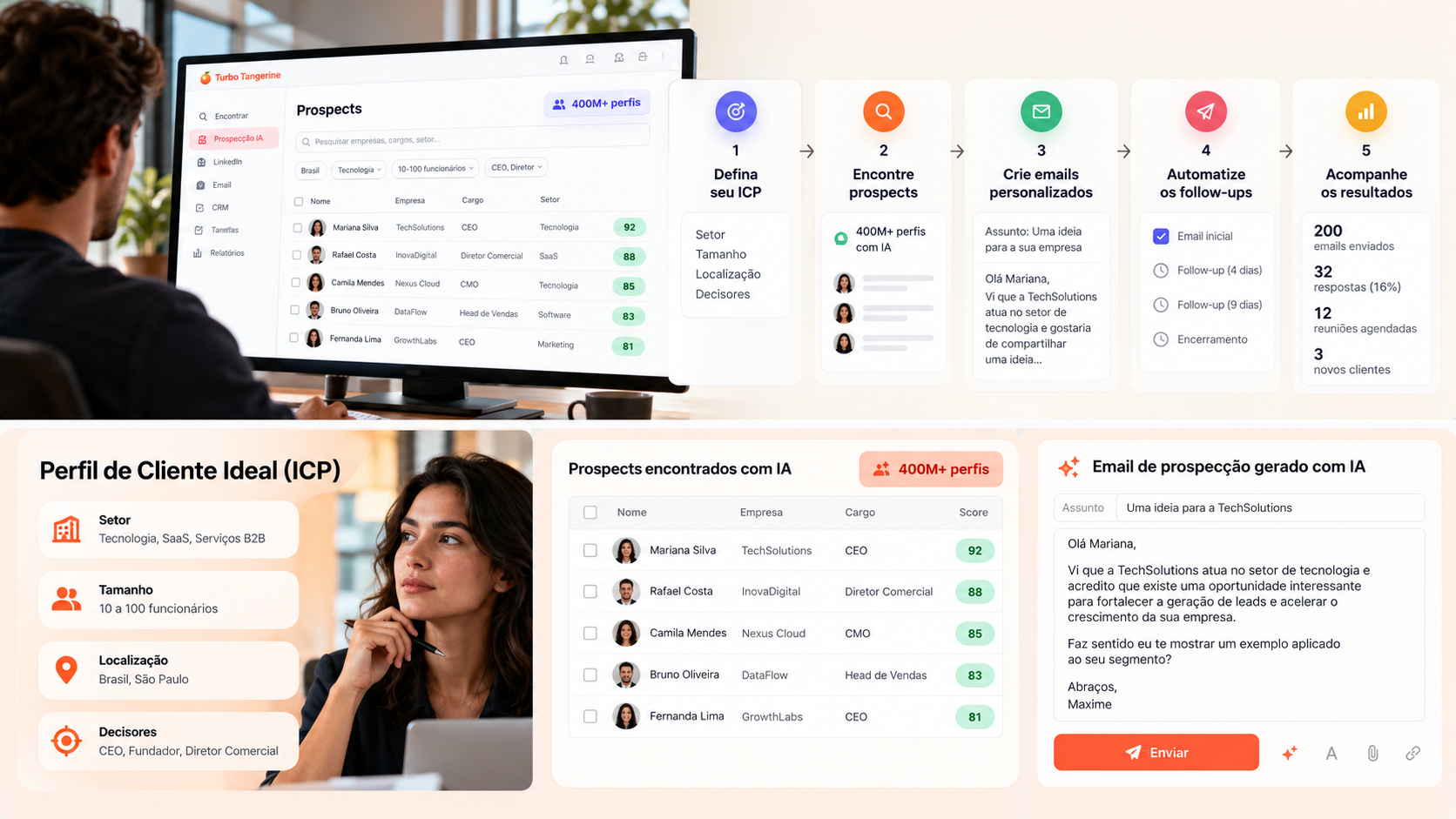
Turbo already provides an AI-assisted prospect search, a CRM with lists and pipelines as well as prospecting workflows combining search, enrichment and contact sequences.
LinkedIn campaigns can then manage connections, messages and reminders, while leads and conversations are centralized on the platform.
The goal is not simply to have more data.
It is to turn that data into business actions at the right moment.
Frequently asked questions about LinkedIn signals
What is a LinkedIn signal in prospecting?
A LinkedIn signal is an event or behavior detected around a prospect or company that may indicate a business opportunity: job change, hiring, interaction with content, profile visit, arrival of a decision-maker or team growth, for example.
What are the best LinkedIn signals for B2B prospecting?
The most interesting signals depend on the product sold. Among the most powerful are usually job changes, hirings, new decision-makers, fundraising, interactions with competitors, team growth and replacement of competing technologies.
Why use several signals at the same time?
A single signal can be ambiguous. Several converging signals allow detecting a much stronger intent. A prospect who matches your ICP, just changed jobs, is hiring and is interested in your subject deserves, for example, a higher priority.
Is it possible to automate signal-based prospecting?
Yes. Signals can serve as triggers to qualify a prospect, add them to the CRM, enrich them, create a task or integrate them into a prospecting sequence. Automation must, however, maintain a contextualized and appropriate message for the situation.
What is the difference between an intent signal and an ICP criterion?
An ICP criterion describes who the prospect is: sector, size, location, role or revenue.
A signal describes what just happened to them: hiring, funding, job change, interaction or technology adoption.
The best prospecting usually combines both :
ICP + signal + timing.
How to prioritize business signals?
It is possible to assign a different score to each event and then combine it with the prospect's fit score. Signals that reveal an important change or a strong intent usually should be weighted more than a simple social interaction.
Conclusion: timing becomes a business advantage
Finding a prospect is no longer necessarily the hardest problem.
Millions of decision makers today can be identified thanks to professional databases, social networks and B2B search engines.
The real competitive advantage is knowing:
who deserves your attention now.
A fundraising, a hiring, a job change, an interaction on LinkedIn, a new technology or the appointment of a decision maker can turn a cold contact into an opportunity.
Signal-based prospecting thus allows replacing a volume logic:
“contact more people”
with a relevance logic:
“contact the right people when there is a concrete reason to talk to them”.
And when these signals are connected to the CRM, scoring and sales sequences, they become much more than data.